
Research
Massive Black Hole Mergers & Gravitational Waves
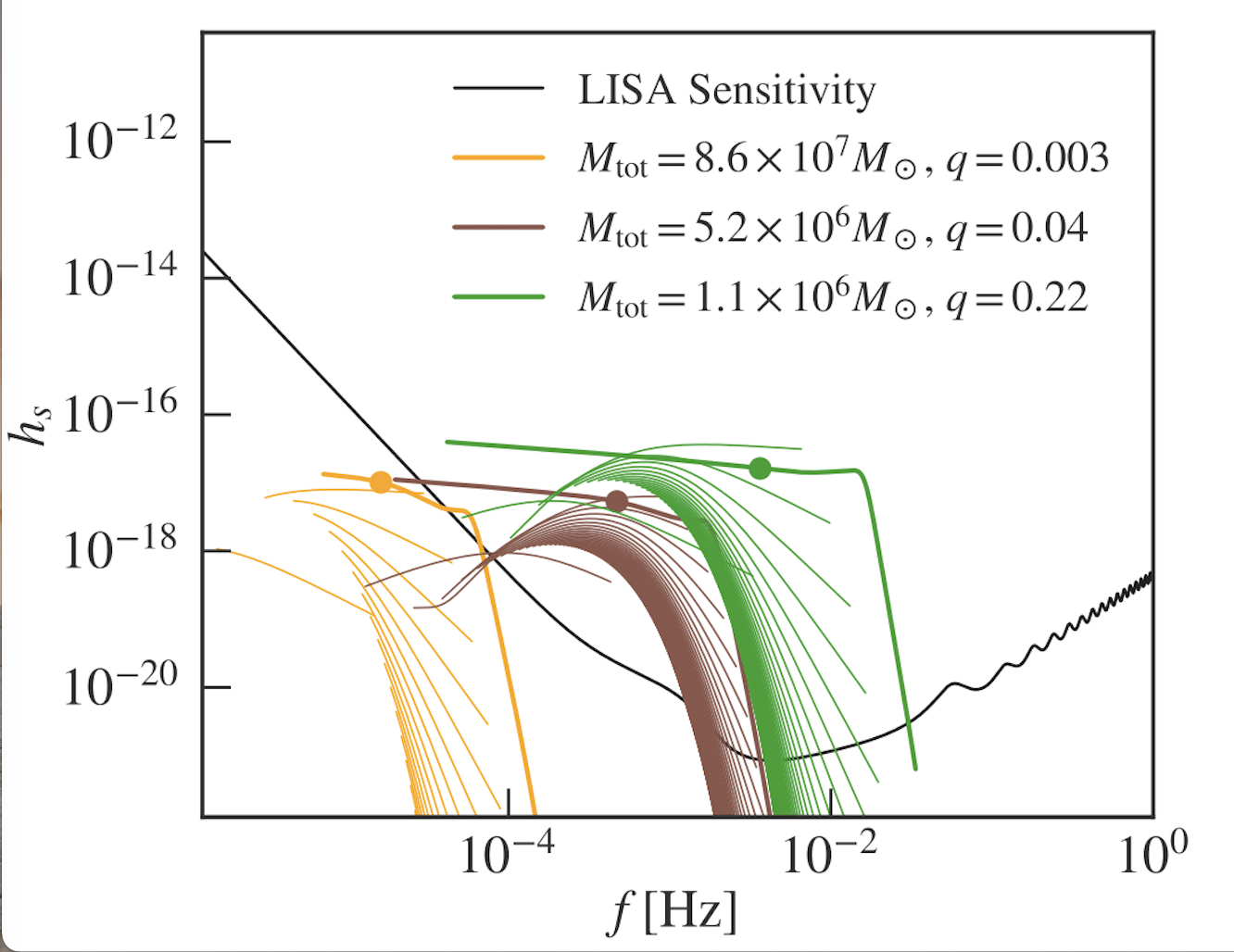
Modeling how massive black holes sink, pair up, and merge in cosmological simulations, and predicting the gravitational-wave signals they produce for LISA and pulsar timing arrays.
Selected papers
-
The Gravitational-wave Background from Massive Black Holes in the ASTRID Simulation
-
MAGICS I. The First Few Orbits Encode the Fate of Seed Massive Black Hole Pairs
-
Massive black hole mergers with orbital information: predictions from the ASTRID simulation
-
Dynamical friction modelling of massive black holes in cosmological simulations and effects on merger rate predictions
Dual & Offset AGN
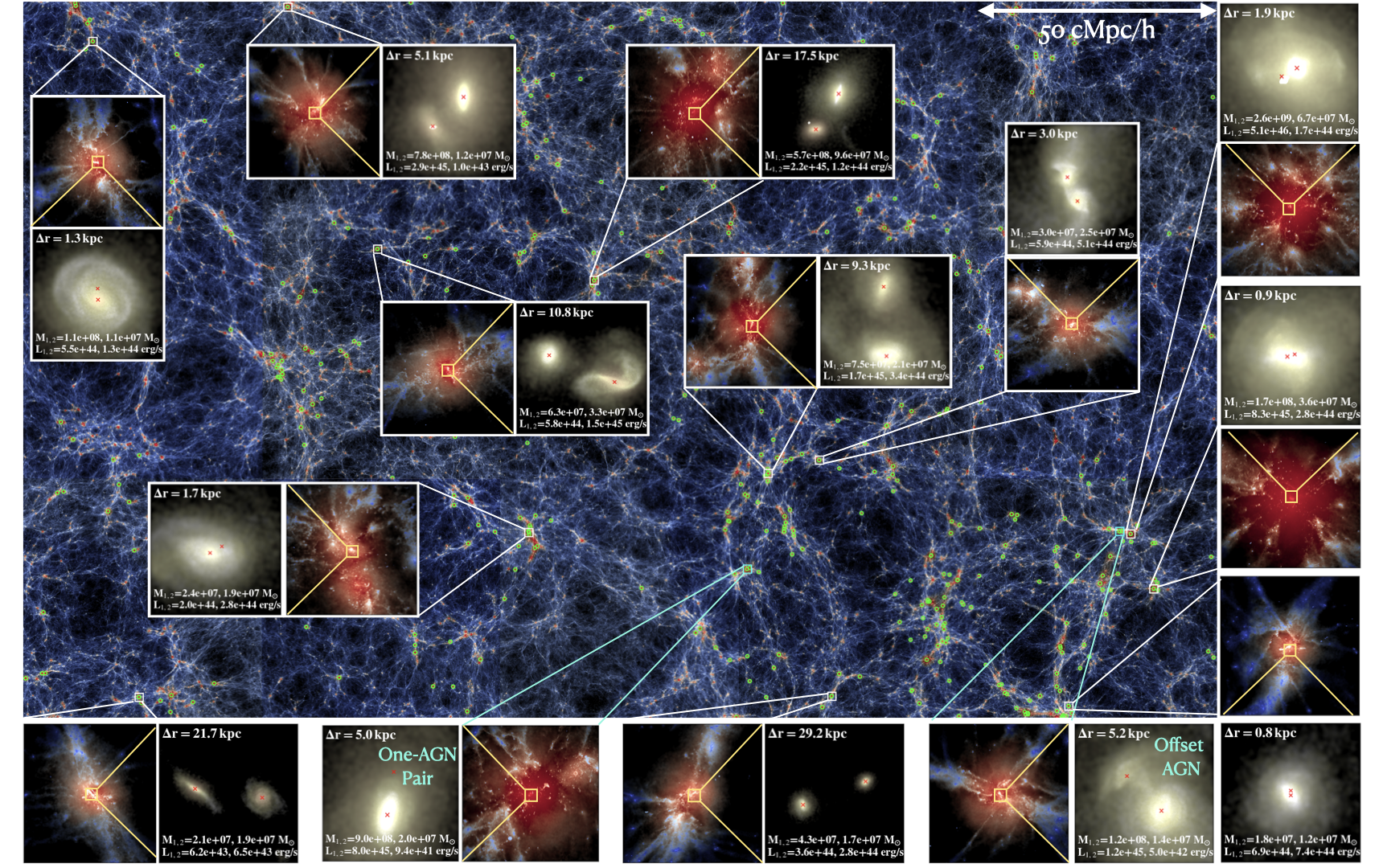
Studying pairs of active black holes on kiloparsec scales, the observable precursors of massive black hole binaries, and connecting simulations to current and upcoming dual AGN searches.
Selected papers
-
Connecting Current and Future Dual Active Galactic Nucleus Searches to LISA and Pulsar Timing Array Gravitational-wave Detections
-
z~2 dual AGN host galaxies are disky: stellar kinematics in the ASTRID Simulation
-
Properties and evolution of dual and offset AGN in the ASTRID simulation at $z \sim 2$
-
A close quasar pair in a disk–disk galaxy merger at z = 2.17
Off-center MBHs
Studying massive black holes that wander away from the centers of their host galaxies, and the observable signatures they leave behind.
Selected papers
-
Flyby Galaxy Encounters with Multiple Black Holes Produce Star-forming Linear Features
-
A vast population of wandering and merging IMBHs at cosmic noon
The ASTRID Simulation
Developing and analyzing ASTRID, a large-volume cosmological hydrodynamical simulation that follows the co-evolution of galaxies and massive black holes across cosmic time.
Selected papers
-
The ASTRID Simulation at z=0: From Massive Black Holes to Large-scale Structure
-
Massive black hole mergers with orbital information: predictions from the ASTRID simulation
-
The ASTRID simulation: the evolution of supermassive black holes
-
The ASTRID simulation: galaxy formation and reionization
Reionization & Cosmology
Modeling the epoch of reionization and its imprint on the cosmic microwave background, and extracting cosmological information from large surveys.
Selected papers
-
Patchy Kinetic Sunyaev–Zel’dovich Effect with Controlled Reionization History and Morphology
-
AMBER: A Semi-numerical Abundance Matching Box for the Epoch of Reionization
-
Data compression and covariance matrix inspection: Cosmic shear
-
SCORCH. III. Analytical Models of Reionization with Varying Clumping Factors